Warm-up
KOB switch
CPR Armbar
X-Pass
Closed Guard punch to loose Triangle
Butterfly head stand passes
Series
Beginner
Knee cut, Farside Armbar
Double Under Pass to Paper Cutter Choke
Intermediate
Chair Sit Backtake, Arm Trap, RNC
Over/Under Pass, North South Choke or Kimura
X-Pass, KOB, Baseball bat
Straight Ankle Lock, Leg Drag
Leg drag, back Ezekiel
Butterfly Arm Crush, Hook Sweep
3/4 Mount to Rolling Back Take
Combo
Headquarters Passing (X, Smash, Knee Cut)
Guard (Hip bump, kimura, Guillotine)
Guard 2 on 1 (Back, Hip Bump, Butterfly Sweep)
Subs from Positions
Mount: Cross Collar, Armbar, Americana, Triangle, Spiral Armbar, Monoplata, Ezekiel
Side Control: Far side Armbar, Americana, Kimura, Arm Triangle, NS Choke
KOB: Baseball bat choke, Far side Armbar, NS Choke
Back Control: RNC, Cross Collar Choke, Wing Choke, Arm bar, Ezekiel
Closed Guard: Kimura, Guillotine, Cross Collar, Omoplata, Triangle
Sweeps from Guards
Closed: Hip Bump, Scissor, Omoplata
Half Guard: Twist Sweep, Butterfly
Butterfly: Hook Sweep, Arm Crush Hook Sweep, 2 on 1 hook sweep
Transitions:
Mount to Tech Mount, Chair sit to back
Side Control to Knee on Belly to Mount
North/South under armpits lift to Back
Tuesday, June 9, 2020

Friday, August 24, 2018
Davi Ramos Seminar
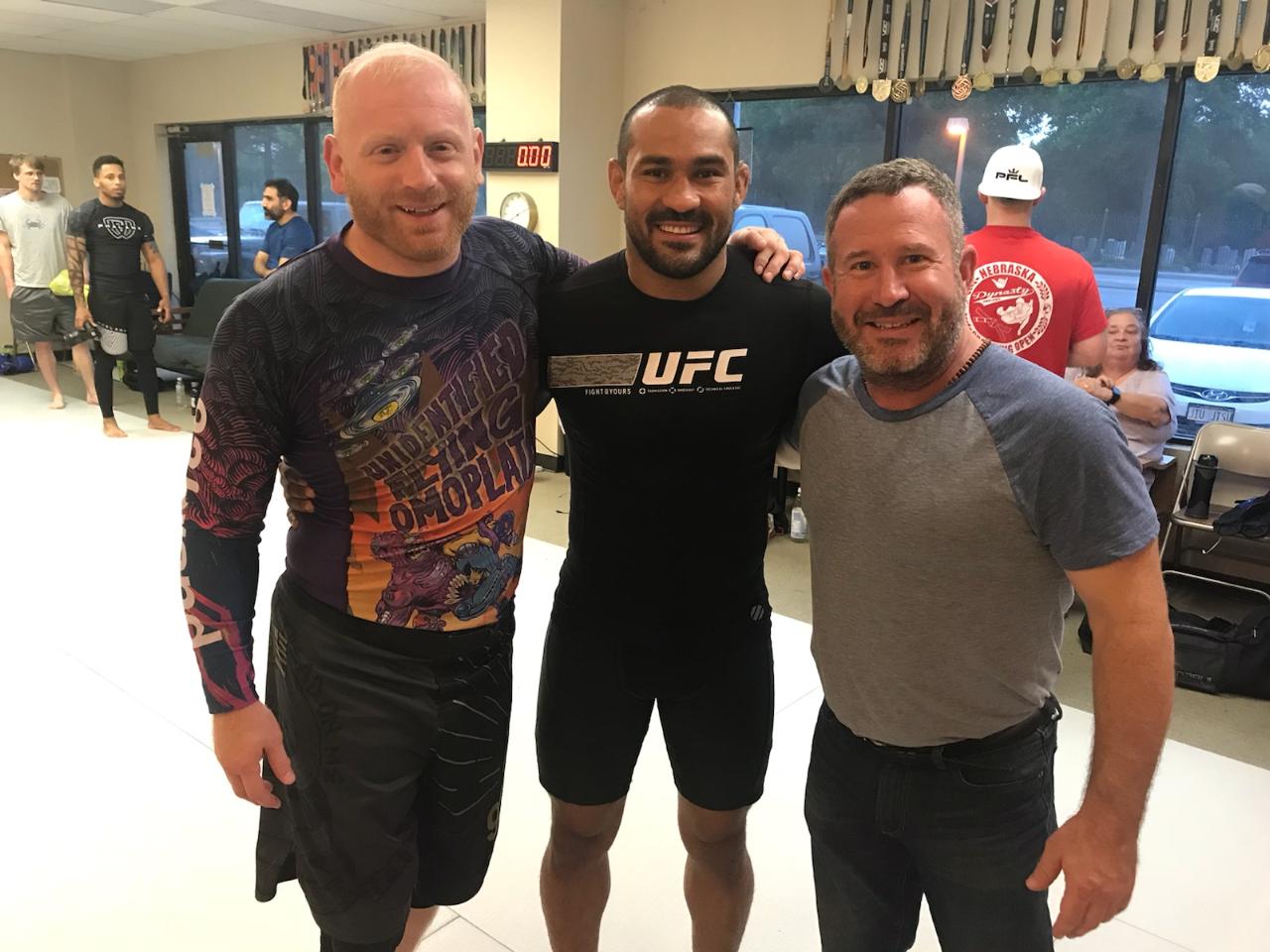
With the UFC in town and some due diligence from Ben Landwear and Henry Ems, we were fortunate to have Davi Ramos give a fantastic seminar at our gym.

He is an ADCC champ as well as an MMA fighter for the UFC with many more accolades. Further more, he was very friendly, personable, funny, and a great teacher.
He recently did a podcast interview on Grappling Central that is worth a listen: http://grapplingcentral.com/episode-299-davi-ramos/
Highlight Video:
The techniques and positions he covered were a good mix of basics ending with some leg entanglement work. I especially liked the small details about a few of the basics that I didn't know.
Passing the Gward
Davi has a very tight passing strategy. We worked from top half guard controlling the legs first then moving up to the hips and finally the arms and head. He talked about using his finger tips to assist with gripping in no gi.
The first drill consisted of getting the underhook and placing our hand in the middle of the opponent's back and then flattening them with a cross face. The hand on the back part was new to me. Then he emphasized closing the legs tight.
Back control
One of the best tips that I'm going to play around with is pinching the knees while in back control to keep them from turning their shoulders.
We worked on a modified body triangle with moving the foot between legs to avoid the escape. The big takeaway for the RNC was to use your cheek to help push their head to assist getting the hand behind neck
Kimura
Starting back from our tight top position in half guard we worked on getting the kimura grip and the Davi showed us the back take he used in his recent MMA fight. We did a shoulder roll, maintaining the grip and when they get up executing kind of a chair sit motion back take. Another good detail here was to hook their shoulder to keep them from getting their back to the mat in transition.
From there he also showed us a vicious scissor choke if they don't try to get up out of the kimura trap.
Armbar from ADCC
Davi talked us through how he setup the armbar in the video below. By repeatedly tying up Lepri's neck and gauging his reactions, until he finally saw his moment to jump into the armbar. We worked on that for a while but I don't think I'll be pulling it off in open mat anytime soon. Well maybe on Mike Wilson.
Q & A
After this he opened it up for some questions. He talked us through his thoughts on half guard. He likes a shallow half with a good bottom hook. He also went over defending a triangle with hip positioning.
Leg Entanglements
I asked how does he decide when it's the right time to go for ankle locks? He showed several quick transitions that were very smooth. Ben seemed to be ready at any moment to tap.
Davi went back to the tight top half guard position and we drilled back step to toe hold, then rolling into knee bar. This is something I think I can incorporate into my game. The last technique we worked on was back step to knee bar that they defend with a triangle, we then kind of moved to the saddle position and controlled the other leg to make a similar lock to the Texas Cloverleaf.


He is an ADCC champ as well as an MMA fighter for the UFC with many more accolades. Further more, he was very friendly, personable, funny, and a great teacher.
He recently did a podcast interview on Grappling Central that is worth a listen: http://grapplingcentral.com/episode-299-davi-ramos/
Highlight Video:
The techniques and positions he covered were a good mix of basics ending with some leg entanglement work. I especially liked the small details about a few of the basics that I didn't know.
Passing the Gward
Davi has a very tight passing strategy. We worked from top half guard controlling the legs first then moving up to the hips and finally the arms and head. He talked about using his finger tips to assist with gripping in no gi.
The first drill consisted of getting the underhook and placing our hand in the middle of the opponent's back and then flattening them with a cross face. The hand on the back part was new to me. Then he emphasized closing the legs tight.
Back control
One of the best tips that I'm going to play around with is pinching the knees while in back control to keep them from turning their shoulders.
We worked on a modified body triangle with moving the foot between legs to avoid the escape. The big takeaway for the RNC was to use your cheek to help push their head to assist getting the hand behind neck
Kimura
Starting back from our tight top position in half guard we worked on getting the kimura grip and the Davi showed us the back take he used in his recent MMA fight. We did a shoulder roll, maintaining the grip and when they get up executing kind of a chair sit motion back take. Another good detail here was to hook their shoulder to keep them from getting their back to the mat in transition.
From there he also showed us a vicious scissor choke if they don't try to get up out of the kimura trap.
Armbar from ADCC
Davi talked us through how he setup the armbar in the video below. By repeatedly tying up Lepri's neck and gauging his reactions, until he finally saw his moment to jump into the armbar. We worked on that for a while but I don't think I'll be pulling it off in open mat anytime soon. Well maybe on Mike Wilson.
Q & A
After this he opened it up for some questions. He talked us through his thoughts on half guard. He likes a shallow half with a good bottom hook. He also went over defending a triangle with hip positioning.
Leg Entanglements
I asked how does he decide when it's the right time to go for ankle locks? He showed several quick transitions that were very smooth. Ben seemed to be ready at any moment to tap.
Davi went back to the tight top half guard position and we drilled back step to toe hold, then rolling into knee bar. This is something I think I can incorporate into my game. The last technique we worked on was back step to knee bar that they defend with a triangle, we then kind of moved to the saddle position and controlled the other leg to make a similar lock to the Texas Cloverleaf.
Wednesday, August 22, 2018
New Classes at LBJJC
It was recently announced that new classes would be offered at LBJJC: Jiu-Jitsu Lab and Drilling, Judo for BJJ, and Advanced Youth. Since I'm teaching one of them I decided to dust off the blog to explain my thoughts on these new additions.
Advanced Youth:
I think it's a great addition as many of the kids are ready for more challenges and more mat time. I think it will be a great transition to get them ready to eventually move to the adult classes as well as get them ready for competitions.
Judo for BJJ:
I completely vouch for Bob's skills and teaching ability. I started training for Masters Worlds in early 2017 and Bob was a huge piece of making me feel more confident in my stand-up. I encourage anyone to attend as we don't always get enough time to work on stand-up especially if the class is packed.
I was in the office the other day when Greg purchased a crash pad. This is a fantastic piece of equipment that our school has needed. It obviously helps the person being thrown to take the fall easier, but it's also great for the thrower to put a little more oomph into the throw.
One of the biggest positives to this class will be learning to fall safely. This is something I believe all martial artists should be good at. In fact it may come in useful when the sidewalks are iced over. You'll also be able to decide where the match goes. You can still pull guard but it's good to also be able to have a few techniques to bring the match to the ground on your terms. You'll be more difficult to take down. Your balance will improve and you'll learn body control to avoid being taken down.
Jiu-Jitsu Lab and Drilling:
Drilling has become a quintessential part of my progress in BJJ. I think it's the best way to incorporate new things to your Jiu-Jitsu and to get the things that you are already good at to that next level.
In early 2017, Greg introduced me and some other students to the Grappling Improvement Plan Sheet and had us choose things to improve on. Along with some techniques that were already a part of my game I added the crucifix position, a position I hardly used unless I accidentally ended up there. After several weeks of drilling the position when I could it started to become a big part of my game and now I finish submissions regularly from there. Without putting the time into the position through drilling and just trying to add it in through rolling I think I would have abandoned it long ago.
Class description: Students will fill out a grappling improvement plan worksheet with techniques they want to drill during the class. The class will have 8 timed drilling rounds and sparring at the end.
New
students: If a new student attends the class they will be shown 1 or 2
basic techniques (escaping mount, side control, scissor sweep, etc) or
techniques from the weekly curriculum. They will then drill those
techniques for all of the rounds.
Advanced Youth:
I think it's a great addition as many of the kids are ready for more challenges and more mat time. I think it will be a great transition to get them ready to eventually move to the adult classes as well as get them ready for competitions.
Judo for BJJ:
I completely vouch for Bob's skills and teaching ability. I started training for Masters Worlds in early 2017 and Bob was a huge piece of making me feel more confident in my stand-up. I encourage anyone to attend as we don't always get enough time to work on stand-up especially if the class is packed.
I was in the office the other day when Greg purchased a crash pad. This is a fantastic piece of equipment that our school has needed. It obviously helps the person being thrown to take the fall easier, but it's also great for the thrower to put a little more oomph into the throw.
One of the biggest positives to this class will be learning to fall safely. This is something I believe all martial artists should be good at. In fact it may come in useful when the sidewalks are iced over. You'll also be able to decide where the match goes. You can still pull guard but it's good to also be able to have a few techniques to bring the match to the ground on your terms. You'll be more difficult to take down. Your balance will improve and you'll learn body control to avoid being taken down.
Jiu-Jitsu Lab and Drilling:
Drilling has become a quintessential part of my progress in BJJ. I think it's the best way to incorporate new things to your Jiu-Jitsu and to get the things that you are already good at to that next level.
In early 2017, Greg introduced me and some other students to the Grappling Improvement Plan Sheet and had us choose things to improve on. Along with some techniques that were already a part of my game I added the crucifix position, a position I hardly used unless I accidentally ended up there. After several weeks of drilling the position when I could it started to become a big part of my game and now I finish submissions regularly from there. Without putting the time into the position through drilling and just trying to add it in through rolling I think I would have abandoned it long ago.
Class description: Students will fill out a grappling improvement plan worksheet with techniques they want to drill during the class. The class will have 8 timed drilling rounds and sparring at the end.
Grappling Improvement Plan Sheet: To determine what techniques to put on your sheet,
try to find a good mix of things you're already good at, new techniques,
and techniques that solve a consistent problem during rolling. Also
feel free to contact the coaches that you work with the most and know
your Jiu-Jitsu game to get ideas.
Students
are encouraged to research their techniques by finding video
instructionals and adding them to the sheet. There is also a section
for recording notes and successes with the techniques throughout the
week.
Class
Format: Students will be given 5 minutes to get warmed up and stretch
on their own. From there, students will partner up and the timer will be
started with 4 minute rounds with 30 second rest for 8 rounds.
Gi/No
Gi: Students are asked to bring both gi and no gi gear to each
session. Currently we will be doing No Gi on the first Monday of the month. But it is subject to change if we find a schedule that works better. It is also possible to train both gi and no gi in a given session by wearing a rash guard under the gi top and removing it when needed.
Sparring:
students can do positional sparring related to the techniques that they
drilled with 2-4 three minute rounds. Finishing with open free rolling.
Friday, January 12, 2018
Technique rules of the gym
This post is about the techniques rules at the gym. What you can and cannot do at each belt level. Also some thoughts on how to treat your training partners
A lot of our class rules coincide with the competition rules for IBJJF tournaments. Here's a link to the IBJJF Rule Book v4.0 in case you're curious but if you've just started Jiu-Jitsu you may want to wait to thumb through it when you've had a couple of months of training. This PDF might be more helpful as a quick guide: Technical Fouls & Illegal Moves Poster (pdf)
That being said there are a lot of different types of tournaments and rule sets and we'll often modify our training based on the upcoming tournament's rules. Whether that's for points, submission only, gi and no gi, ADCC, no time limit, combat jiu-jitsu, etc.
Remember while it is a combat sport and martial art, we must take care of our training partners. A common expression is "don't break your toys." We want everyone to avoid injuries and be able to train as often as they can. Furthermore, knowing when you need to tap is paramount.
Techniques that are prohibited for everyone:
Slamming or throws that puts your partners head/spine in danger (suplex)
A common example of slamming is having a person in your closed guard, standing up, and then dropping them to the ground with force and landing on top of them. There are videos on youtube that are titled "How to get DQ'd in BJJ" It is a very dangerous technique and can cause damage to your training partner's back, neck, and head.
That said, we should not ignore it completely and learn how to defend against a slam. Whether it's self defense situation or you are rolling with someone that isn't familiary with our rules it's good to protect yourself. Here's a decent video with some options: How to Not Get Slammed in the Guard
Small Joint locking (Fingers and Toes)
You are not allowed to grab individual fingers in order to escape a submission or in the process of attempting your own. You may grab all of the fingers together, but any single digit manipulation is not safe for your training partner.
Techniques like eye gouging, fish hooks, hair pulling, groin strikes, biting, etc.
These are probably obvious and I'm probably missing some. Again for self defense purposes we should be aware that these things can happen, but they have no place in our average class.
Heel hooks and reaping the knee in the Gi
The heel hook is one of the strongest submissions in BJJ and has found some popularity lately in sub-only no gi events. It is a general rule in Gi BJJ tournaments that heel hooks are not allowed along with reaping the knee because of the added friction the gi provides.

Prohibited techniques for white belts specifically
So that would imply the techniques above are fine for blue belts and above. I would still stress some caution when it comes to new blue belts or other blue belts you don't normally roll with or visitors to the club. It's perfectly fine to ask, "what do you think about toe holds and knee bars?" as you slap and bump before the roll. Once you've established that you and your partner are both good with them, then it's probably fine to use them in future rolls.
Reminder that heel hooks and reaping are not allowed in the gi at any level, only no gi.
Also it's good to keep in mind that many of these techniques are still not allowed in tournaments that you might compete in, so get familiar with the rules of the tournament you are preparing for.
A lot of our class rules coincide with the competition rules for IBJJF tournaments. Here's a link to the IBJJF Rule Book v4.0 in case you're curious but if you've just started Jiu-Jitsu you may want to wait to thumb through it when you've had a couple of months of training. This PDF might be more helpful as a quick guide: Technical Fouls & Illegal Moves Poster (pdf)
That being said there are a lot of different types of tournaments and rule sets and we'll often modify our training based on the upcoming tournament's rules. Whether that's for points, submission only, gi and no gi, ADCC, no time limit, combat jiu-jitsu, etc.
Remember while it is a combat sport and martial art, we must take care of our training partners. A common expression is "don't break your toys." We want everyone to avoid injuries and be able to train as often as they can. Furthermore, knowing when you need to tap is paramount.
Techniques that are prohibited for everyone:
Slamming or throws that puts your partners head/spine in danger (suplex)
A common example of slamming is having a person in your closed guard, standing up, and then dropping them to the ground with force and landing on top of them. There are videos on youtube that are titled "How to get DQ'd in BJJ" It is a very dangerous technique and can cause damage to your training partner's back, neck, and head.
That said, we should not ignore it completely and learn how to defend against a slam. Whether it's self defense situation or you are rolling with someone that isn't familiary with our rules it's good to protect yourself. Here's a decent video with some options: How to Not Get Slammed in the Guard
Small Joint locking (Fingers and Toes)
You are not allowed to grab individual fingers in order to escape a submission or in the process of attempting your own. You may grab all of the fingers together, but any single digit manipulation is not safe for your training partner.
Techniques like eye gouging, fish hooks, hair pulling, groin strikes, biting, etc.
These are probably obvious and I'm probably missing some. Again for self defense purposes we should be aware that these things can happen, but they have no place in our average class.
Heel hooks and reaping the knee in the Gi
The heel hook is one of the strongest submissions in BJJ and has found some popularity lately in sub-only no gi events. It is a general rule in Gi BJJ tournaments that heel hooks are not allowed along with reaping the knee because of the added friction the gi provides.

Prohibited techniques for white belts specifically
- Wristlocks: Any pain compliance techniques using the wrist
- Twisting Ankle Locks: Toe Holds, Heel Hooks, Estima Locks
- Knee Bars
So that would imply the techniques above are fine for blue belts and above. I would still stress some caution when it comes to new blue belts or other blue belts you don't normally roll with or visitors to the club. It's perfectly fine to ask, "what do you think about toe holds and knee bars?" as you slap and bump before the roll. Once you've established that you and your partner are both good with them, then it's probably fine to use them in future rolls.
Reminder that heel hooks and reaping are not allowed in the gi at any level, only no gi.
Also it's good to keep in mind that many of these techniques are still not allowed in tournaments that you might compete in, so get familiar with the rules of the tournament you are preparing for.
Wednesday, October 11, 2017
October 6th & 7th - Cole Franson Seminar
Cole Franson is a brown belt that trains at Tinguinha HQ and is an avid competitor. Check out some of his matches on youtube. Greg brought him out to give us a taste of a different style of BJJ from a high level competitor.
I didn't take as good of notes as I normally do for a seminar so a lot of this is from memory and I probably forgot some of it. I plan on using much of this as I enjoy guillotines. I'd like to get good at berimbolos some day but it just hasn't been a focus of mine yet. I did enjoy the lasso stuff that we did though.
Cole ended up rolling a lot and he looked smooth and always in control. For my experience rolling with him, I didn't ever feel like I got him in a position that I wanted him in. I attempted my over/under pass and I couldn't push his foot down between my legs. I put him in deep half and I couldn't hold him tight to my shoulder. When I tried to pass his guard he inverted and kind of walked back up into me and reguarded. So I have a lot to learn still, duh.
We had an unfortunate accident Friday night as my buddy Craig dislocated his elbow while posting on a scissor sweep. We got him taken care of at the hospital where they relocated it and doped him up a bit. Then back home safely that night.
 |
| I'm in the background wishing I was rolling instead |
 |
| For some reason we look more happy than we should in this photo. Probably the drugs |

Friday
Techniques Covered:
- Guillotine with chinstrap grip
- Headlock position
- They defend by grabbing wrist, butterfly hook sweep
- Situp guard: push head to the outside back step sit pass
- Get to Side Control
- Opponent does Side control escape with underhook
- Fall into Guillotine as they situp
- If they don't come up, mount
- If they roll the other way, anaconda
Saturday
Techniques Covered:
- Reverse De La Riva Kiss of the Dragon backtake
- If they lean back, waterfall to back
- If they lean forward, hold hips to get up
- If they sit balanced and grab feet, grab higher on their lapel and butterfly sweep to one side
- De La Riva Berimbolo Back Take
- Lasso
- Invert to Sweep
- If they switch legs, DLR sweep to invert to omoplata
Monday, September 11, 2017
Beginner Curriculum Technique Companion Links
This week I completed a post for each week of the curriculum. These are the requirements to get promoted to blue belt. I've included a link to a youtube video for each technique, unfortunately I wasn't able to always find a video that matched the way we do things 100%. Please let me know if you find a better video that represents what we do for a given technique or if any of the links are broken. Hopefully this helps you potential woul blue belts out there.
Week 1
Techniques: O-Soto Gari, Basic Side Control Knee Escape, Paint Brush (Americana) from Side Control
Week 2
Techniques: Standing RNC Defense: Seio Nage, Farside Armbar From Side Control, Scissor Sweep
Week 3
Techniques: O-Goshi, Cross Collar Choke from Closed Guard, Armbar from Closed Gaurd
Week 4
Techniques: Standing Headlock Escape to Tani Otoshi, Kneeling Guard Break, Single Under Pass
Week 5
Techniques: Double Leg, Mount: Cross Collar Choke, Upa
Week 6
Techniques: RNC Defense with O-soto gari, Back Mount: Escape, RNC
Week 7
Techniques: Seoi Nage, Back Mount Lapel Choke, Guillotine from Guard
Week 8
Techniques: Technical Stand-up, Closed Guard: Hip Bump Sweep, Kimura
Week 9
Techniques: Koshi Guruma, Standing Guard Break, Torreando Pass
Week 10
Techniques: Standing Guillotine Defense, Half Guard: Back Take, Recover Full Guard
Week 11
Techniques: O-Soto Gari, Half Guard Knee Slide Pass, Turtle Granby Roll
Week 12
Techniques: Leg Over Headlock Escape, Turtle Turnover to Side Control & Back Mount
Week 13
Techniques: O-Goshi, Back Mount: Wing Choke, Bow and Arrow Choke
Week 14
Techniques: Standing Headlock Escape to Hammerlock, Mount: Armbar, Elbow Escape
Week 15
Techniques: Double Leg, Mount Americana, Side Control Bread Cutter
Week 16
Techniques: Koshi Guruma, Side Control: Tripod Escape, Kimura
Week 17
Techniques: Standing Guillotine Against Wall Defense, Kneeling Guard Break, Double Under Pass
Week 18
Techniques: Seoi Nage, Double Ankle Grab Sweep, Butterfly Hook Sweep, Butterfly Guard Pass
Week 19
Techniques: Headlock Escape to Back Mount, Kneeling Guard Break, Knee Slide Pass
Week 20
Techniques: Koshi Guruma, Basic Triangle Setup
Week 21
Techniques: Basic Open Guard Position, Sweeps, and Submissions (Collar Sleeve Guard)
Week 22
Techniques: Guillotine Defense from Guard, Ezekiel Choke from Mount & Half Guard
Week 23
Techniques: Head Lock Escape Over Head Roll, Straight Footlock and Defense
Week 1
Techniques: O-Soto Gari, Basic Side Control Knee Escape, Paint Brush (Americana) from Side Control
Week 2
Techniques: Standing RNC Defense: Seio Nage, Farside Armbar From Side Control, Scissor Sweep
Week 3
Techniques: O-Goshi, Cross Collar Choke from Closed Guard, Armbar from Closed Gaurd
Week 4
Techniques: Standing Headlock Escape to Tani Otoshi, Kneeling Guard Break, Single Under Pass
Week 5
Techniques: Double Leg, Mount: Cross Collar Choke, Upa
Week 6
Techniques: RNC Defense with O-soto gari, Back Mount: Escape, RNC
Week 7
Techniques: Seoi Nage, Back Mount Lapel Choke, Guillotine from Guard
Week 8
Techniques: Technical Stand-up, Closed Guard: Hip Bump Sweep, Kimura
Week 9
Techniques: Koshi Guruma, Standing Guard Break, Torreando Pass
Week 10
Techniques: Standing Guillotine Defense, Half Guard: Back Take, Recover Full Guard
Week 11
Techniques: O-Soto Gari, Half Guard Knee Slide Pass, Turtle Granby Roll
Week 12
Techniques: Leg Over Headlock Escape, Turtle Turnover to Side Control & Back Mount
Week 13
Techniques: O-Goshi, Back Mount: Wing Choke, Bow and Arrow Choke
Week 14
Techniques: Standing Headlock Escape to Hammerlock, Mount: Armbar, Elbow Escape
Week 15
Techniques: Double Leg, Mount Americana, Side Control Bread Cutter
Week 16
Techniques: Koshi Guruma, Side Control: Tripod Escape, Kimura
Week 17
Techniques: Standing Guillotine Against Wall Defense, Kneeling Guard Break, Double Under Pass
Week 18
Techniques: Seoi Nage, Double Ankle Grab Sweep, Butterfly Hook Sweep, Butterfly Guard Pass
Week 19
Techniques: Headlock Escape to Back Mount, Kneeling Guard Break, Knee Slide Pass
Week 20
Techniques: Koshi Guruma, Basic Triangle Setup
Week 21
Techniques: Basic Open Guard Position, Sweeps, and Submissions (Collar Sleeve Guard)
Week 22
Techniques: Guillotine Defense from Guard, Ezekiel Choke from Mount & Half Guard
Week 23
Techniques: Head Lock Escape Over Head Roll, Straight Footlock and Defense
September 2017 - Week #9 Technique Companion
Theme & Techniques: Koshi Guruma, Standing Guard Break, Torreando Pass
Koshi Guruma
Video: Judo - Koshi-guruma
Similar footwork to other forward throws. This one in particular you want to make sure that you don't push their hips back when you wrap your arm around your neck. This week, I'm going to focus primarily on turning my head with the throw to end looking behind me.
Standing Guard Break
Video: Barra Technique Tuesday - Passing the Closed Guard
One of the most important techniques is the standing guard break. The exercise that went the furthest for getting this to work for me was the stand-up and sit-up that we worked on in a competition class. It's one of my favorite exercises to have the class do when I teach. Being able to standup with good posture and structure is crucial, especially if your opponent is bigger than you. A couple of tips that I think are important:
Bonus: 3 Ways to Break the Closed Guard
Torreando Pass
Video: BJJ Scout: Leandro Lo's Toreando Pass Study
There are a lot of videos out there on this technique and a lot of people have different ideas of what works best. I found the video linked above to contain the most variation of information. Some tips for the technique:
Koshi Guruma
Video: Judo - Koshi-guruma
Similar footwork to other forward throws. This one in particular you want to make sure that you don't push their hips back when you wrap your arm around your neck. This week, I'm going to focus primarily on turning my head with the throw to end looking behind me.
Standing Guard Break
Video: Barra Technique Tuesday - Passing the Closed Guard
One of the most important techniques is the standing guard break. The exercise that went the furthest for getting this to work for me was the stand-up and sit-up that we worked on in a competition class. It's one of my favorite exercises to have the class do when I teach. Being able to standup with good posture and structure is crucial, especially if your opponent is bigger than you. A couple of tips that I think are important:
- I always look up about 10 degrees above eye level, even during grip fighting.
- If they occupy their own hand with a grip, it's okay to plant that foot. As you stand, attempt to grab the sleeve and control.
- Pull them up by their sleeve trying to keep their shoulders off the mat.
- Put the palm of your hand on the boney part of their knee.
- Take short steps back as you push down.
Bonus: 3 Ways to Break the Closed Guard
Torreando Pass
Video: BJJ Scout: Leandro Lo's Toreando Pass Study
There are a lot of videos out there on this technique and a lot of people have different ideas of what works best. I found the video linked above to contain the most variation of information. Some tips for the technique:
- Create handles on the inside of the knees with knuckles down
- Get your opponent on their back by pushing their knees into the direction of their chest
- Practice the footwork in combination with the arm movements to make it a smooth path to knee on belly
- You will likely have to switch sides to complete the pass
Subscribe to:
Posts (Atom)